johndoe@gmail.com

Eighty years ago, the Nuremberg Trials reached their conclusion. After almost a year of proceedings, the International Military Tribunal (IMT) delivered its verdicts against the leading figures of Nazi Germany, bringing one of the most significant trials in modern history to an end.
The IMT was established by the Allied powers to prosecute leading members of the Nazi regime for aggressive war, war crimes and crimes against humanity. The main trial began at the Nuremberg Palace of Justice in November 1945 – but in subsequent years, the United States led twelve further proceedings against a wider range of officials, military officers, judges, doctors and industrialists.
Nuremberg was a pivotal episode in the aftermath of World War II. For the first time, senior political and military leaders were held individually accountable before an international tribunal for crimes committed in the name of the state. The proceedings made clear that those responsible for atrocities could not evade justice by claiming they were merely following orders or acting on behalf of their government. In doing so, the tribunal established principles that would shape the future development of international criminal law.
While others received prison terms or were acquitted, twelve leading Nazi figures were sentenced to death. This included Martin Bormann, Head of the Nazi Party Chancellery, who was sentenced to death in absentia, though he had in fact died in 1945. Hermann Göring, Commander-in-Chief of the Luftwaffe, escaped hanging by taking a cyanide capsule the night before his scheduled execution. However, the executions of ten condemned men who remained in custody, including Foreign Minister Joachim von Ribbentrop, took place on 16th October 1946.
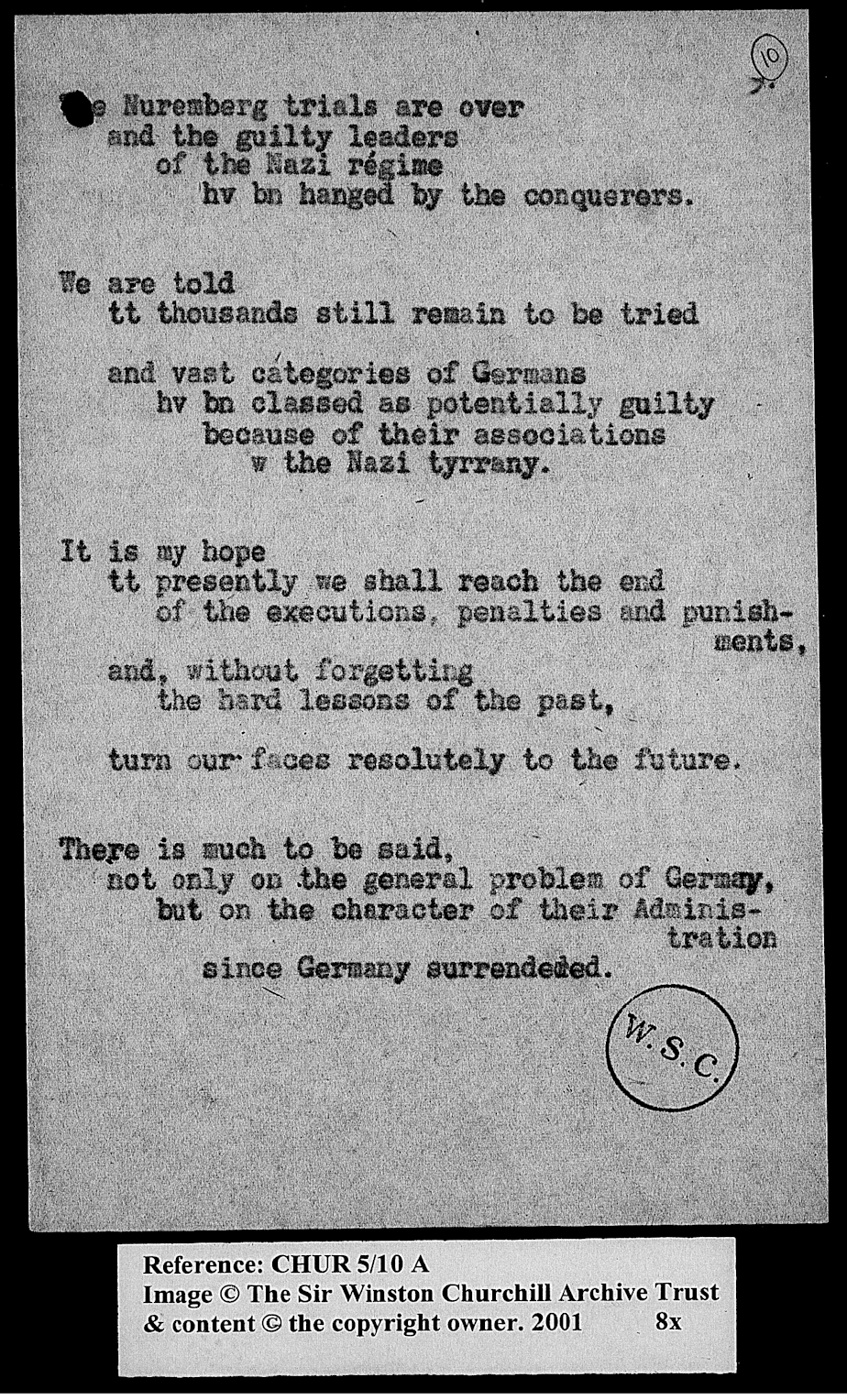
The conclusion of the main trial raised broader questions about the future. How should those found guilty be punished? Once the principal leaders had been brought to justice, should the Allies continue pursuing large numbers of people associated with the former Nazi regime? And how should they approach Germany's recovery? These issues were among those considered by Winston Churchill when he addressed the House of Commons on 12th November 1946, only weeks after the verdicts had been delivered. The notes for that address offer valuable insight into his thinking on the aftermath of Nuremberg and the future of Europe.
Churchill had long supported efforts to bring Nazi leaders to justice. Yet in November 1946 he warned against allowing punishment to become an open-ended process of collective retribution. His comments reflected growing concern about the transition from wartime justice to post-war reconstruction. He did not suggest that Nazi crimes should be forgotten, nor that the guilty should escape accountability. Instead, he questioned the wisdom of extending punishment to large numbers of ordinary Germans. Living under a dictatorship, he argued, was not in itself evidence that an individual had supported what the regime had done.
In distinguishing between those responsible for Nazi crimes and the wider German population, Churchill also acknowledged the immense challenges facing Europe after the war. Germany had suffered catastrophic destruction, while millions across the continent faced poverty, displacement and uncertainty. Allied occupation could not continue indefinitely without a plan for recovery and, ultimately, self-government.
The speech illustrates the difficult balance confronting the Allies in 1946. While justice had been delivered against the principal leaders of the Nazi regime, Europe also faced the urgent task of rebuilding. Churchill recognised that lasting peace would depend not only on punishing past crimes but also on creating the conditions for political stability and economic recovery.
His message was not a rejection of Nuremberg but a warning about what should follow it. Once those most responsible had been brought to justice, Europe needed to move from retribution towards reconstruction. The challenge was to remember the horrors of Nazism and ensure such crimes could never be repeated while creating the foundations for post-war order.
The Nuremberg verdicts remain a landmark in the history of international justice, and Churchill's 1946 address provides an illuminating perspective on the difficult questions that followed the trials: how to deliver justice for unprecedented crimes while laying the foundations for lasting peace.
➜ CHUR 5/10A/10: Speeches: speech notes.